
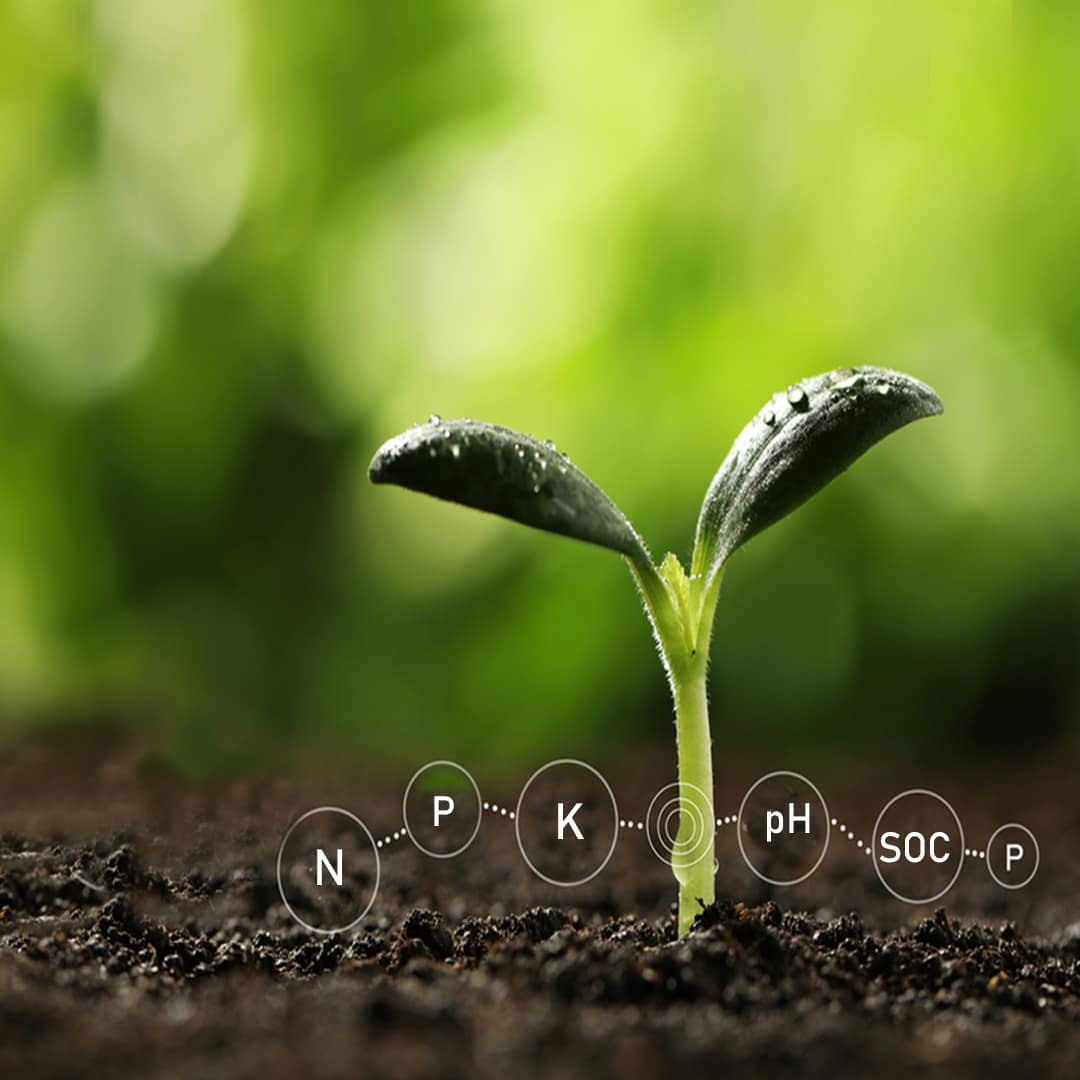
Soil Testing can be done for your Farm in 2 Minutes through Sat2Farm.
Why Soil Testing?
Soil Nutrient impact on plant growth was established back in the 1700s by eminent scholars like Dokuchev, Liebig and others. But, soil testing as a practice of soil fertility management was not popular until the mid or late 1940s. Soil testing plays an important role in understanding the built-in resource structure of soil where cultivation is to be taken. This information is critical for understanding whether the soils can provide sufficient nutrients for optimal crop development. Major concern in the farming community is whether adding fertilizer would increase yield and whether it will be profitable. Though there is a strong link between input usage and production, the confused application of fertilizer is not the solution.
Negative to popular belief, usage of excess input in the form of fertilizers will not always promise them better yields. The excess use of fertilizers can alter pH of the soil, deteriorate the soil health and make it barren. It not only adds to the expenses of crop production but also leaves a deep wound on the environment. This will push the farmers into the clear of “double loss”.
Furthermore, a variety of variables other than weak soil fertility may contribute to poor crop output. Thus, each fertilizer suggestion should be based on soil analysis, research on crop response to fertilizer in a specific location. And also the farmer’s practices and management level can be considered. The link between agronomic research and its practical application is the soil test targeted at soil fertility assessment.
Soil Health and It’s Importance
Healthy soil is the biggest opportunity for the entire agricultural industry and also the environment. At the same time, maintaining soil health has been the biggest challenge. From the days of shifting agriculture/ today’s view as a sustainable profession, soil has been the initial point of interest. As soil is what decides the entire plant species bio geography. There are many advanced methods of breeding, biotechnology and other crop improvement strategies. But soil properties are still the top contributors to healthy crops and better yields.
The importance of soil has been very well-established in the present day scenario. With many notable celebrities, governments, and other institutions taking up the issue and helping to the best of their capability. One such effort is to issue soil health cards to every farmer in the country by the government of India. Now, this initiative is focused on providing benefits to both farmers and also the environment. The scheme aims at promoting soil-test-based and balanced use of fertilizers to realize higher yields at lower cost. The main objective is to inform growers of the applicable amount of nutrients depending on the crop and quality of soil.
Demerits of traditional Soil Testing methods
The majority of the soil testing from the day of its advent is done in soil testing laboratories. The soil samples are collected following various methods, from different parts of the field. Sample is drawn out of it using the quadrant method. Presently, there are 661 soil testing laboratories, including 120 mobile vans operating in 608 districts of the country. There is a major advantage of precise information from soil testing laboratories. But the extent and spread are not sufficient to cover the entire length and breadth of the country. And also the time, effort and cost of soil sampling and analysis for the entire country would be enormous.
The sampling also demands a great deal of manpower, which is very scarce and valuable in the agriculture sector. Also farmers cannot afford the errors in sampling. Thus soil analysis through remote sensing can be an effective method. Because of affordability, sustainability in soil health and the time pressure.
What is Remote Sensing?
Remote sensing is the addition of information from a distance. Various space agencies ( NASA, ISRO) observe Earth and other global bodies. Using sensors aboard satellites that detect and record reflected or emitted energy. Remote sensors provide a global perspective and a wealth of data about Earth systems. Enable data-informed decision making based on the current and future state of our planet.
Available global satellite data provide information in several wavelengths at higher spatial resolution (~10 m). Through this we can now monitor the farms and get valuable insights into the farm remotely also. With the help of satellite data, soil moisture, crop health, flood loss, soil nutrients can be easily and regularly gathered.
Satyukt with the expertise in remote sensing were able to create a platform Sat2Farm. Wherein, the farmers just have to walk around their farm and geo tag it. The regular information specific to their farms will be available within less than 10 minutes.
Sat2Farm Mobile and Web app
Now you can easily access and visualize the satellite data over any farm on the globe. Satyukt Analytics has developed mobile applications (https://play.google.com/store/apps/details?id=com.satyukt.myfarmapp). There is a web application too (www.sat2farm.com). The data availability always for each of the farmers at their fingertips certainly strengthens the decision-making process. It ultimately optimizes the resource utilization as a whole.

Crop nutrient deficiency detection using Remote sensing
Satyukt analytics with the help of multi spectral remote sensing data explored the soil nutrient content estimation. Five nutrients: N, K, P, pH and OC can be estimated across India. This can be done through optical remote sensing data (Landsat-8 and Sentinel-2), terrain/climate data and ground truth value. This way, there is a potential to generate a high resolution (<; ha) soil nutrients map. It can be done for every farm in the country irrespective of their size.
This method of soil nutrient estimation is reliable, quick and actionable, saving a lot of effort in soil sampling/cost. The cumbersome and time-consuming process of soil macro-nutrient testing for every farm will be done with Sat2Farm. It will be readily available with the farmer himself for reference. This will help in determining the extent of crop nutrient deficiency in different pockets of the farm. It also comes up with remedies that would benefit the nutrient uptake in crops, hence increasing the overall crop yield.


| Range | Nitrogen(Kg/Ha) | Standard Soil rating |
| Average | 271 | 280-560 kg/ha (Normal) |
| Minimum | 247 | < 280 Kg/ha (Low) |
| Maximum | 288 | > 560 Kg/ha (High) |
Remarks: The nitrogen content of the field is lower than normal. Extra nitrogen applied at split intervals in the form of urea would improve the crop’s use efficiency of nitrogen, and also the yield of the crop.
| Range | Phosphorus (Kg/Ha) | Standard Soil rating |
| Average | 19 | 10-24 kg/ha (Normal) |
| Minimum | 15 | <10 Kg/ha (Low) |
| Maximum | 21 | > 24 Kg/ha (High) |
Remarks: The amount of phosphorus in the field is within the standard range.
Conclusion:
Through the Sat2Farm mobile application, the report is available at every guntha level or 100 sq. m. It allows the farmer to precisely understand the land nutrient requirement and plan his fertilizer application. Remarks provided along with the report will better equip the farmers and give the best picture imaginable for his farm.
Visualization of a farm in terms of nutrient content is a great leap forward in adopting smart and precise agriculture. Will align the nation’s interest in developing and making precision agriculture accessible and affordable to each and every farm holder.
For more information, reach out to us at connect@satyukt.com or +91 7019992797.
Please visit Sat2Farm to know all the features of the app.


