
How to gain optimum ‘Farm scale soil moisture using Satellite’ from your soil?
Soil moisture, the water held within the soil pores in liquid or vapour phase is the major factor that supports plant growth. Plants can readily absorb water if the moisture content of the soil is optimum. Knowledge of spatio-temporal variation of soil moisture is of utmost importance as it helps in understanding the health of crops and can thereby predict soil agricultural yield.
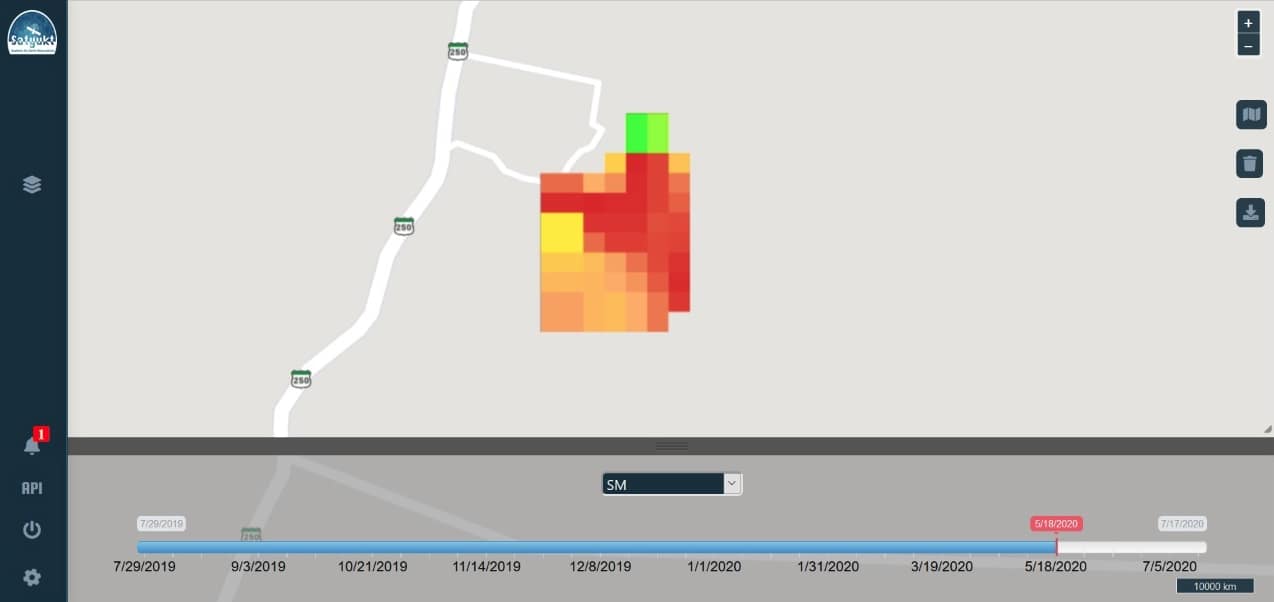
The conventional way of measuring soil moisture is to install soil moisture sensors in the ground which measure the volumetric water content indirectly by using properties of the soil, such as electrical resistance, dielectric constant, or interaction with neutrons etc. But this method is time-consuming and has limited coverage. Alternatively, soil moisture can be measured using the multi-temporal satellite data which provides better coverage. At Satyukt we have an in-house built algorithm to compute soil moisture using multi-satellite data including optical as well as microwave remote sensing to offer soil moisture data at the high spatio-temporal resolution, which can be used to monitor the small farms of size less than 1 ha. The figure above soil moisture for a farm in Karnataka, depicting farm level soil moisture.
Some of the applications where soil moisture is useful are:
- Optimal irrigation in farms
- Identify areas being over-irrigated
- Improved flood risk estimation
- Monitor agricultural drought in near real-time
- Improved weather forecast
- Analyze the impact of an irrigation project
- Identify the irrigated area by an irrigation source
- Automatic billing of farm based on the actual irrigation
- Estimation of actual evapotranspiration taking place
- Estimation of the area getting degraded
Contact us to register in our portal Micro and to find out pricing details at contact@satyukt.com. We will be happy to address all your exciting questions. In the meantime, have a look at satyukt.com for more information about us.


