
Precision irrigation can revive agriculture in arid Rajasthan
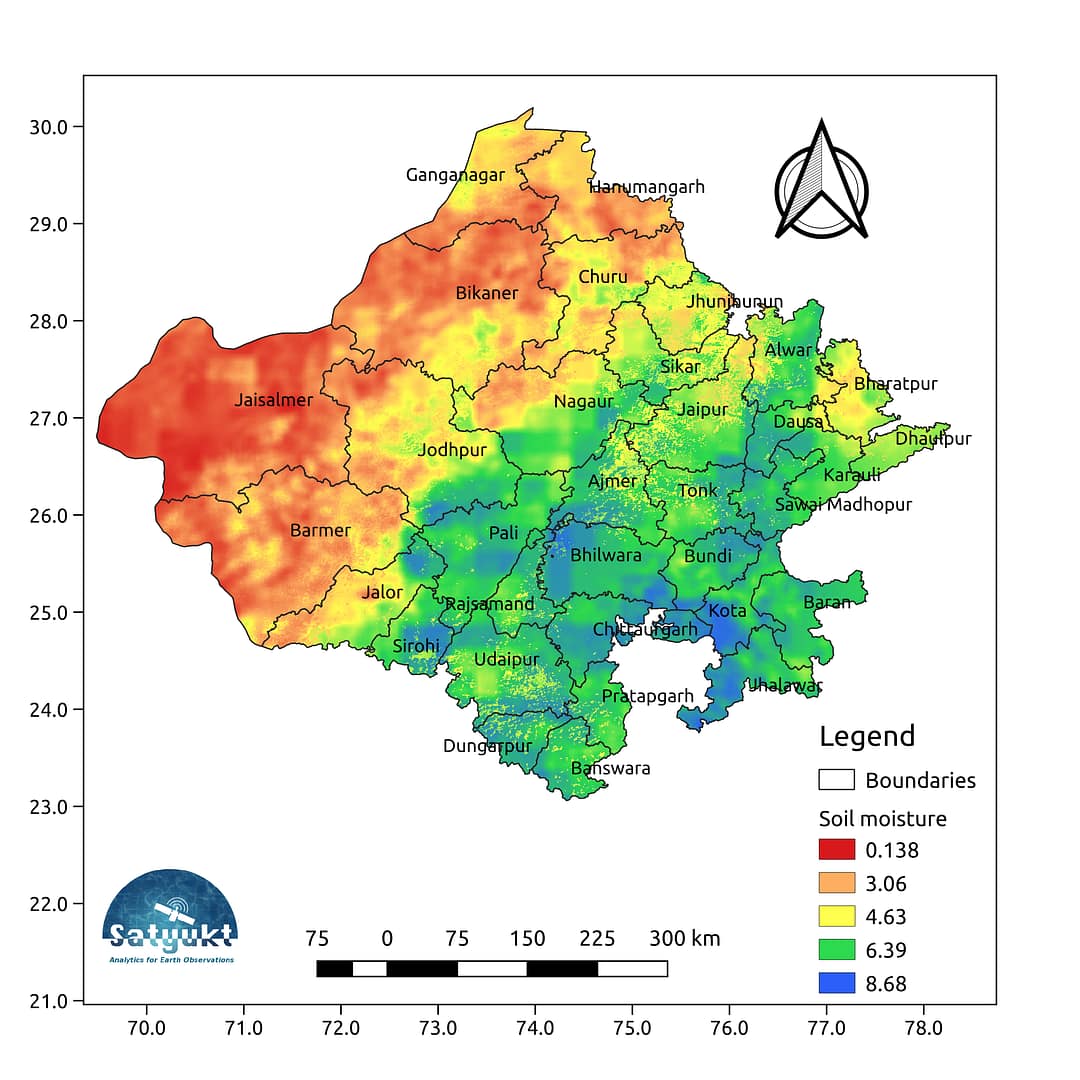
Rajasthan receives an annual rainfall less than 25 cm and hence the agriculture relies mostly on irrigation, which often becomes unprofitable. As water remains one of the limiting factors in the agriculture sector of the state, calculating irrigation requirement of the soil types spatiotemporally would be advantageous. Proper usage of water can increase the yield and crop health.
Precision irrigation is the practice of irrigating the crops with the optimal amount of water. The land-atmosphere interactions can be modeled and analyzed to predict crop-water requirement, agricultural yield, extreme events that may affect the agriculture yield (Floods, droughts etc) or simulate water budget. The underlying parameters that change with these interactions, such as the soil moisture, Evapotranspiration, normalized difference vegetation index (NDVI), Vegetation Condition Index (VCI) can be beneficial to analyze these interactions. With the recent advancements in remote sensing, the near real-time monitoring of these agro-hydrological parameters under all-weather conditions is possible, as observations made in the microwave frequency domain is insensitive to aerosols and clouds.
The spatial variation of Actual evapotranspiration of the state is as shown in the figure. Evapotranspiration is cumulative of water lost from the capillary fringe of the groundwater table and the water lost by the plants whose roots meet the capillary fringe. On a barren land or land at the time of sowing, water is predominantly lost due to evaporation, as the crop grows the fraction of evaporation decreases and transpiration increases since the crop canopy covers the ground beneath it. At sowing, nearly 100% of ET comes from evaporation, while at full crop cover more than 90% of ET comes from transpiration. ET is an important component of water and energy balance of climate-soil-vegetation interactions and hence is regarded as vital in water resources management. Evapotranspiration is one of the main parameters that influence crop health, monitoring which in near real-time is beneficial for farmers to adopt different agricultural practices for the betterment of yield.