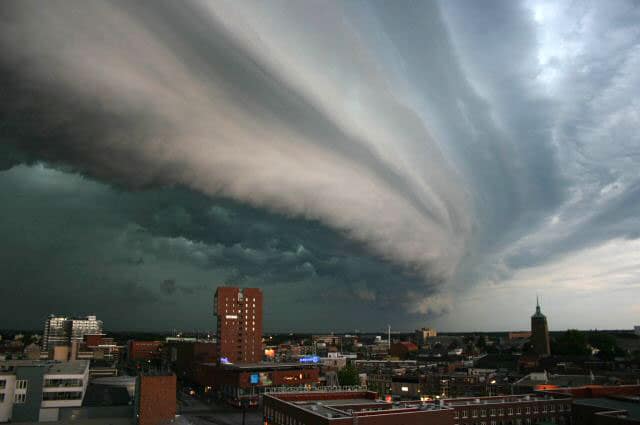
Rain has a dramatic effect on agriculture as it forms one of the effective ways of watering in many parts of the country. While a regular rain pattern is vital for crop health, too much or too little rainfall can prove harmful to crops. Analyzing the formation of rain will help in reviving agricultural adaptation options and can help in the betterment of the yield. The impact of soil moisture on cloud formation and precipitation has been the subject of several studies. Holtslag et al.and Heerwaarden et al examined the role of soil moisture on cloud development in terms of humidity tendency equation, where a number of land�surface and atmospheric processes are involved. The study observed the effect of soil moisture on the atmospheric boundary layer (ABL) and concluded that it impacts �top relative humidity and thus has the potential for ABL cloud formation. Fast et al. used a large‐eddy simulation model and an interactive land surface parameterization to simulate the complex population of shallow clouds observed on 30 August 2016 in north‐central Oklahoma. The study clearly observed that cloud distributions are governed by soil moisture.
In the last few decades, Earth Observation (EO) technology has played an increasingly important role in determining soil moisture. Soil moisture data is provided by optical, passive and active microwave sensors (Moran et al) . Optical sensors may not retrieve data, if it is cloudy during the satellite pass and hence cannot provide the retrieval data throughout the year. Passive microwave sensors provide soil moisture globally at a coarser spatial resolution whereas active microwave sensors have a higher spatial but low temporal resolution (2–4 weeks). Using soil moisture data directly from any of these satellites will have compromised spatial or temporal resolution.
Tomer et al has developed an algorithm (MAPSM) that merges active and passive microwave satellite data to retrieve soil moisture at 20m spatial resolution. Employing this high resolution soil moisture, Satyukt Analytics has developed an operative model that represents the interactive land-atmosphere system which generates physical and numerical measurements of climate parameters. Using the proprietary algorithms, the interaction of the land-surface with the atmospheric boundary layer and the subsequent effect on boundary-layer cloud development can be analyzed in near-real-time.
With advancements in remote sensing, satellite data is used in numerous fields, including geography, land surveying, military, intelligence, commercial, economic, planning, and humanitarian applications. almost all fields. Analyzing cloud formation will also help in representing the cloud fraction, precipitation, and cloud radiative effects simulated by convective parameterizations which can help in making the satellite estimated parameters better and devoid of clouds.