
Why should we monitor soil moisture?
Soil is a conglomeration of solids, liquid and air components. The solids consist of organic matter, minerals and micro-organisms. Liquid mainly comprise the water held between the solids and air comprises gaseous components released by various microbial processes, recycling of nutrients and exchange of gases with atmosphere occurring in the soil medium. Soil forms a medium in which plants grow, a habitat for microbes and animals with all the essential nutrients required. Soil is thus a vital component to life on earth.
Soil type varies from place to place depending on the bedrock and resulting distribution of particles which result in varying percentages of sand, silt and clay. More the percentage of clay more is the water holding capacity of soil. Main source of water to the soil is precipitation and flow of water from upstream. The water gets collected in the soil pores and is utilized for various processes happening in the soil column. The sunlight falling on the bare soil causes loss of water as evaporation. The plants extract the major quantity of water through the root system and is lost to the atmosphere as evapotranspiration. The microbial community in the soil also uses the water present in the soil column for various processes. The other way water gets lost from the system is drainage where the water moves from top layer to the lower layers reaching groundwater in the end or resulting in subsurface flow reaching streams. This returning water to the environment affects the climate of the region.
So, the more we understand about soil moisture, the better we will be able to identify plants that are suited for particular conditions. The knowledge of soil moisture proves very helpful in irrigation scheduling in the agricultural areas, crop selection, recharge to ground water and surface water. Overall, better we understand the natural ecosystem, better we can utilize it for the benefit of humans without harming the environment. Modifications done by humans for example include replacement of native vegetation with agricultural crops and withdrawal of water from surface and ground water resources. There will be imbalance created in the environment if water intensive crops are grown in water scarce area and if over exploitation of surface and ground water is practiced. These issues can be addressed only when the soil moisture fluctuations are studied, and actions are taken based on the water availability.
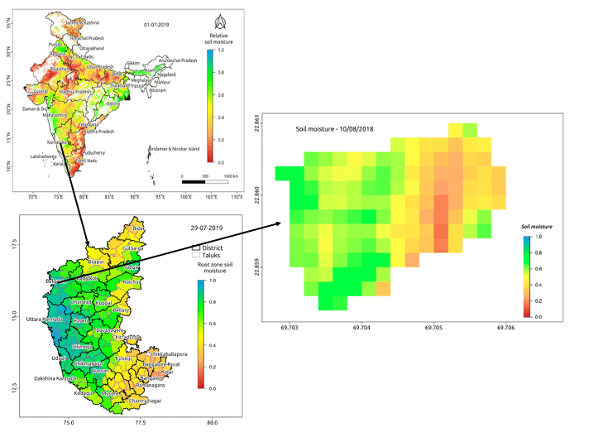
At Satyukt analytics we monitor global soil moisture using multiple remote sensing products. Here is an example shown in the figure where the soil moisture on a daily basis at farm scale in Belgaum district, Karnataka state, India is provided as a product to the farmer and using such information the farmer can effectively manage water resources in their farm to adapt to the changing environmental conditions.


