
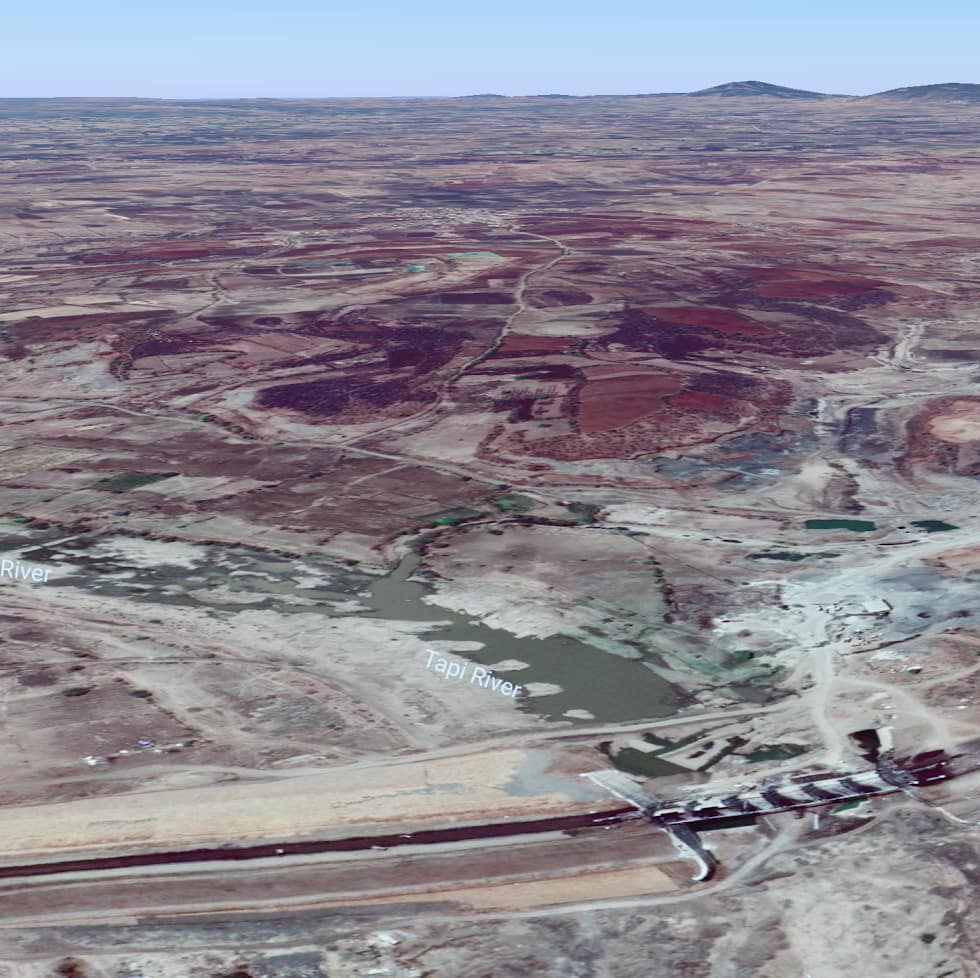
Case study: Trend Analysis in hydrological data
Problem:
Once it is decided to build a reservoir on a river by constructing a dam across it, it is necessary to compute a suitable design capacity for the reservoir. The design storage of a reservoir is computed considering the following factors;
- Precipitation, run-off and silt records available in the region
- Erodibility of catchment upstream of the reservoir for estimating sediment yield
- Area capacity curves at the proposed location
- Trap efficiency
- Losses in the reservoir
- Water demand from the reservoir for different uses
- Committed and future upstream uses
- Criteria for assessing the success of the project
- Density current aspects and location of outlets
- Data required for economic analysis and
- Data on engineering and geological aspects.
Challenges
The practice followed in India is to plan the design storage of the reservoir for a target demand of not more than 75% dependable yield by assuming that the hydrological processes involved are stationary. This ensures that the dam is filled 75% throughout its design period. However, when there is a non-stationarity in hydrological process, the yield of the dam may not be the estimated one due to the climatic and anthropogenic changes and recursive occurrence of extreme events such as floods and droughts. Hence uncertainty in the hydrological process should also be considered in the design.
R. K. Mall et.al.,2006, has reviewed various studies on the Impact of Climate Change on Indian agriculture. The study states that there is clear evidence for an observed increase in global average temperatures and change in rainfall rates during the 20th century according to the studies done by Easterling, 1999; IPCC, 2001; Jung et al., 2002; Balling Jr and Cerveny, 2003 and Fauchereau et al., 2003. Studies reveal that Climate change and anthropogenic activities are significant in India. Analysis done by India meteorology department, The Indian Institute of Tropical Meteorology and Intergovernmental Panel on climatic changes (IPCC) revealed a positive trend of temperature, heatwave, glaciers droughts, and floods.
Although climatic changes and the extreme events can be modeled using Global Circulation Model (GCM), the climate data provided by GCMs have significant uncertainty and can not be easily used for the adaptation in hydrological projects.
Solution
Streamflow was separated into the surface runoff and baseflow to understand the impact of climate change and anthropogenic changes. The anthropogenic change was found to be having a more profound impact than climate change in historical data.

Fig.1: The streamflow separated into the baseflow and runoff is shown over time. As it can be inferred, the baseflow is showing a significantly decreasing trend and have become nearly zero. Hence the assumption of stationarity will not hold good in such conditions.
The Proposed approach identified that the traditional methods followed by the water resources department are 43.35. Hence this approach would be more economical and efficient in designing the storage capacity of reservoirs.