
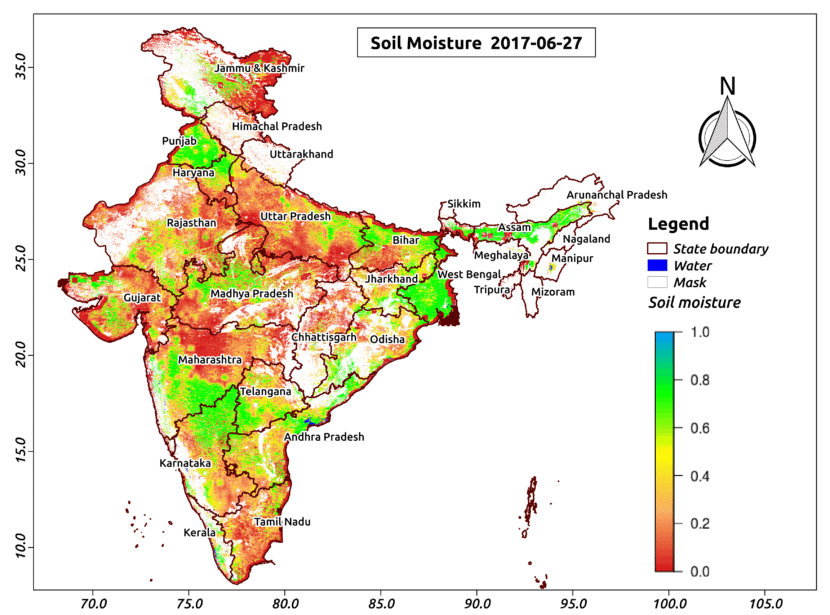
Soil moisture, the water held within the soil pores in liquid or vapour phase is the major factor that supports plant growth. Plants can readily absorb water if the moisture content of the soil is optimum. Knowledge of spatiotemporal variation of soil moisture is of utmost importance as it helps in understanding the health...

Drought is a normal and recurrent condition of climate that occurs when the available soil moisture becomes insufficient to support plant growth. Droughts adversely affect the agricultural sector especially when they are prevailing for a longer duration. Agricultural droughts should be identified well before it’s occurrence to reduce its impact on the crop. Normalized...

Chattisgharh,” The rice bowl” of India mainly practices rain-fed agriculture( 72 per cent of agriculture ) and hence the need to monitor the agriculture stress induced by several factors, such as shortage of water, overuse of pesticides etc is of prime importance. Passive microwave sensors provide soil moisture globally at a coarser spatial resolution...

India has witnessed many natural disasters like floods, landslides, cyclones, forest fires, earthquakes, drought, etc. To comprehend risks due to such disasters, it is necessary to integrate satellite and field-based observations and to work towards risk reduction principles. Satellites provide synoptic observations of the natural disasters at regular intervals that helps in better gearing...

Climatic changes may have drastic effects on Agricultural yield as agriculture is extremely dependent on land-atmosphere interactions. Pradhan Mantri Fasal Bima Yojana (PMFBY) launched in 2016 with an objective to provide insurance protection to farmers against crop losses due to these unforeseen events. The scheme was launched to protect the farmers when these climate...

Soil can “remember” extreme climatic events long after the conditions responsible for the anomaly is forgotten by the atmosphere, is a key aspect of land-atmosphere interactions and has major implications for seasonal forecasting. The land-atmosphere interactions can be modeled and analyzed to predict climate or simulate water budget. After precipitation, a certain amount of...

Precipitations of any form (rainfall, melting snow etc) get stored in the soil due to the pores present in the soil and later contributes to the soil moisture. The temperature, soil characteristics, and more are the factors which help to determine the type of biome present and the suitability of land for growing crops....

Cauvery, the one known for its bitter water dispute between the riparian states extends over states of Karnataka, Andhra Pradesh, Kerala, and the Union territory of Puducherry. The river is facing pollution right from where it originates — the Kodagu district, where it is also honored as the Ganga of the South . The...
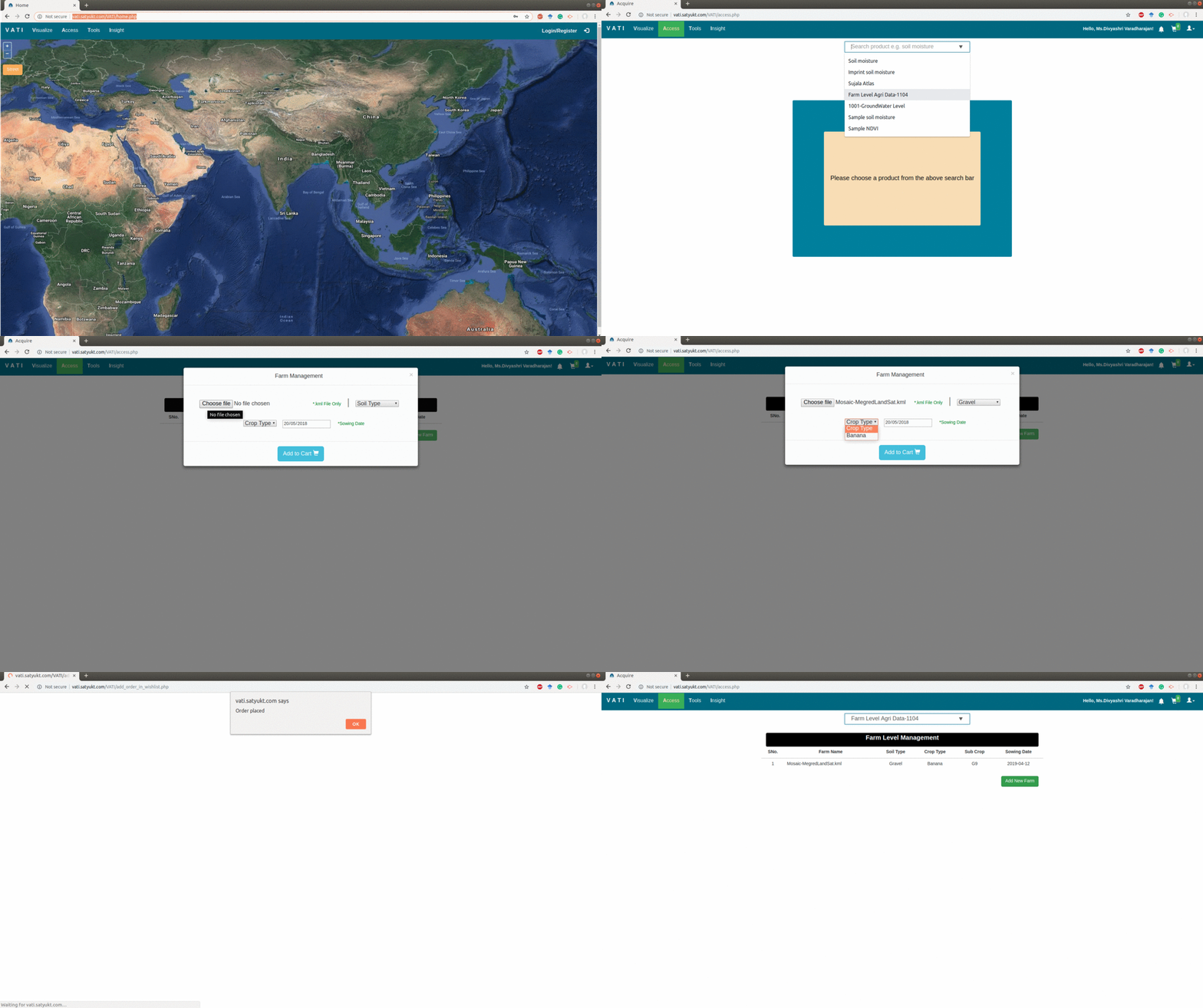
First published on October 11, 2018 Many times, the spatiotemporal variation of yield is observed in the same agriculture land because of the variation in soil structure and properties. The land-atmosphere interactions responsible for these variations can be modeled and analyzed to predict crop-water requirement, crop health and agricultural yield. The underlying parameters(agrohydrological parameters)...

First published on November 15, 2018 Crop health is dependent on Agro-hydrological factors such as soil moisture, soil type, Rainfall, evapotranspiration etc. With the emergence of satellite sensors, these parameters that influence the health of the crops can be monitored and analyzed in near real time. Detecting how these parameters vary over time helps...