
Soil is a conglomeration of solids, liquid and air components. The solids consist of organic matter, minerals and micro-organisms. Liquid mainly comprise the water held between the solids and air comprises gaseous components released by various microbial processes, recycling of nutrients and exchange of gases with atmosphere occurring in the soil medium. Soil forms...
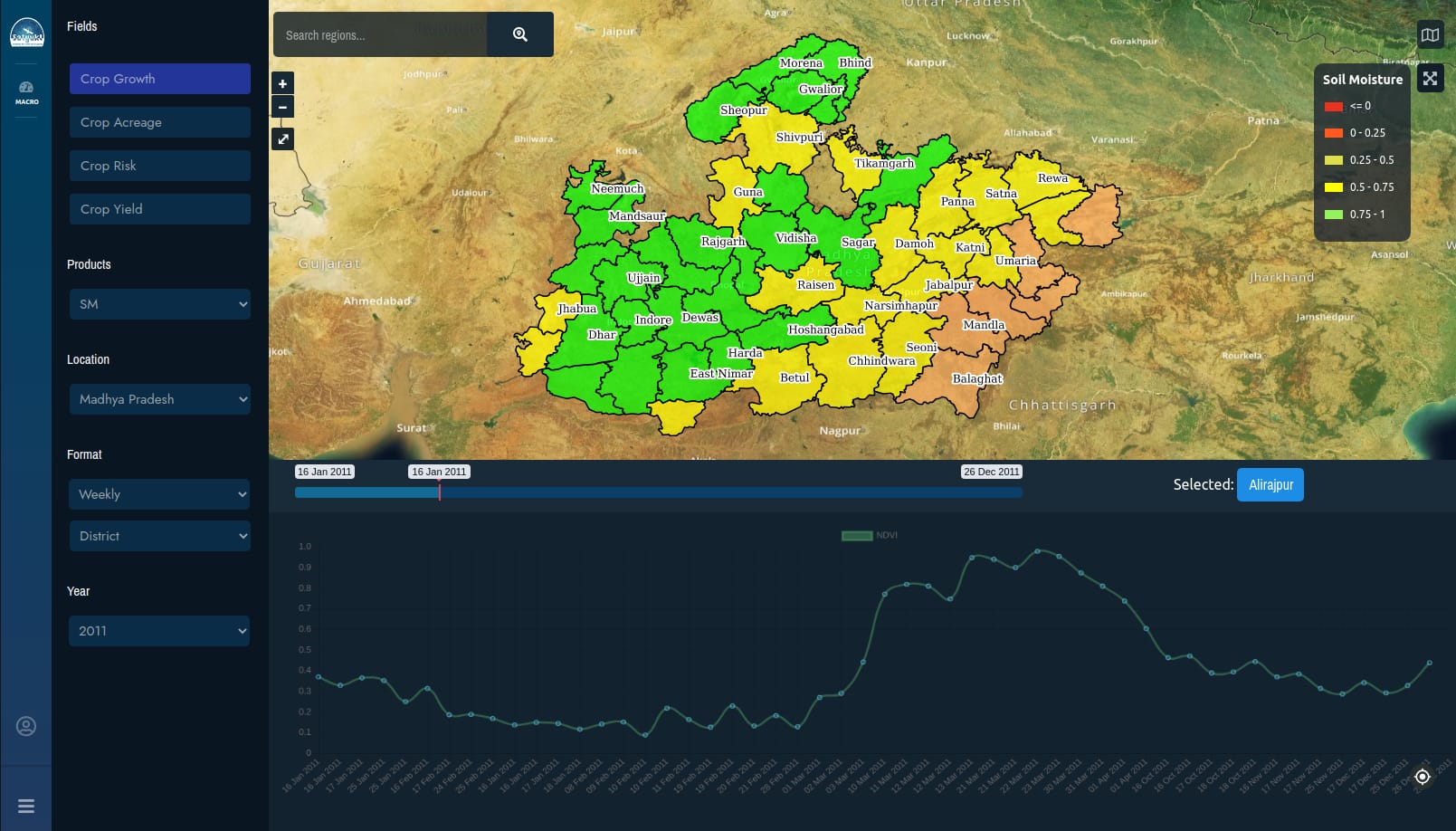
Knowledge of Soil Moisture (SM) is crucial for climatology, meteorology, hydrology and agriculture. But people are unaware of its potentiality to improve agriculture both economically and ecologically. Soil moisture is extremely useful in determining crop water requirements, irrigation management, as well as crop yield but its estimation over large regions and time periods through...

Soil moisture is defined as the water held in the pores of soil and this forms the water reserve available to quench the crop’s water requirement. Rainfall being the primary source of water, fills up the soil reserve which can extend from half meter to one meter in depth from surface or even deeper...

Soil moisture, the water held within the soil pores in liquid or vapour phase is the major factor that supports plant growth. Plants can readily absorb water if the moisture content of the soil is optimum. Knowledge of spatio-temporal variation of soil moisture is of utmost importance as it helps in understanding the health...

In developing countries, drought is a major reason for crop loss. According to FAO, drought accounts for about $48 Billion agricultural losses in the developing countries between 2000-2015. Better irrigation water management can help in mitigating the impact of drought, the success relies on how accurate the soil moisture measurements. Soil moisture can be...

Deficient rainfall triggers water shortage: Is Maharashtra’s severe water crisis staring at drought?
Maharashtra is one of the most industrialized and urbanized states in India, but its GDP is mainly dependent on the agriculture industry. As rainfall deficiency is increasing the share of the agrarian economy in the net state domestic product is decelerating because it depends on rainfall for irrigation. According to IMD, Maharashtra has received...

The Agricultural land of Goa is diminishing at a fast rate due to urbanization and climate change. The agriculture sector of the state contributes only 15-16 per cent of the state’s income although one-fourth of the population is dependent on agriculture. As most of the state practices rain-fed agriculture, knowledge about precipitation, soil moisture...

First published on October 20, 2018 The agrarian economy of Odisha is dependent on Climate and soil. Employing more than 60% of the population agricultural sector of Odisha is the demographically the broadest sector of the state which contributes about 30% of the Gross State Domestic Product (GSDP). Only 20% of the agriculture area...

With 58% water depletion, the river Narmada is depleting at an alarming rate. The river serves as a major source of drinking water, irrigation, and hydroelectricity for the states of Madhya Pradesh and Gujarat. The average Soil moisture map for the month of September over the river basin of the Narmada river clearly shows...
Combined study of NDVI (Vegetation Index) and SM (Soil Moisture) has proved to choose the optimal sowing window for crops. The above study is done for Rajkot district in Gujarat.Rajkot has received close to normal rainfall from 15th June 10th August The relative soil moisture is found to be increased in most of the...